The Q&A · IndustryFP-012 · Side D
Eshy Gazit: Artists Need a Manager More Than a Label
The US manager behind BTS's first American campaign and a decade of Monsta X on why a manager comes before a label, what artist development actually is, and what he looks for before he signs an artist.
Disclosure: First Press operates independently but shares ownership ties with EG Management and LUSIVEX, the companies founded by the subject of this interview. Questions were written by First Press staff; the subject answered in writing and approved the final cut, as with every Q&A we run.
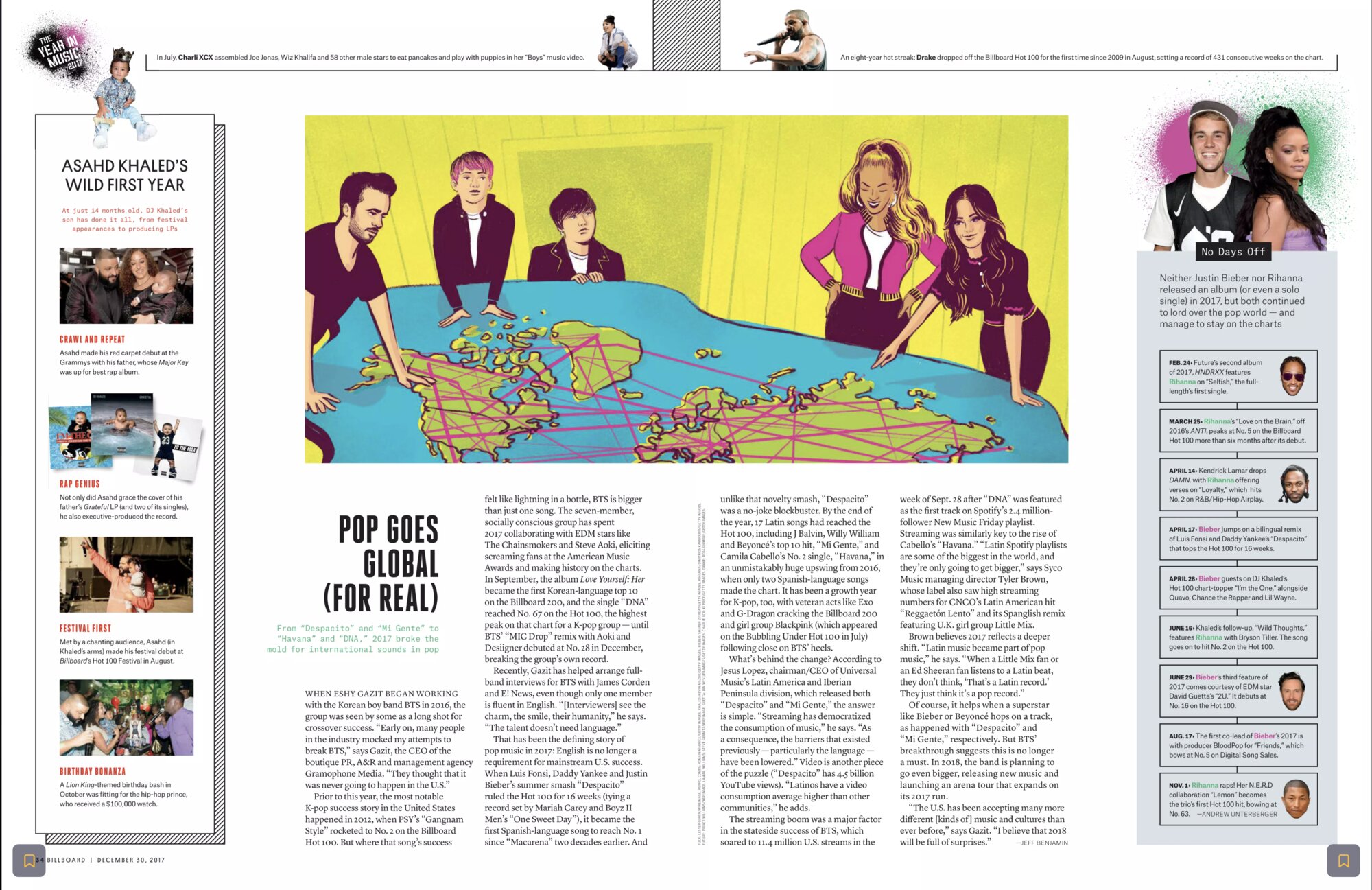
There is a version of the K-pop-in-America story that fits in one sentence, and it is wrong. The version with the dates in it runs through a Brooklyn office in 2016, a television-first plan that most of the industry laughed at, and a manager named Eshy Gazit, who was BTS's US managing partner from 2016 to 2018 alongside Big Hit Entertainment, then took Monsta X to Epic Records, the iHeartRadio Music Festival stage and the Billboard 200 top five with an album sung entirely in English.
Gazit has been a partner at Maverick Management since 2019, founded Intertwine Records in 2021 and runs EG Management and LUSIVEX. Billboard named him an International Power Player in 2021 and 2022. He now describes his job with a phrase he uses on purpose: a US manager for international artists, and he is looking for the next ones to sign.
We sent him thirteen questions about artist development and the job of managing. He answered in writing, the way every Q&A on First Press works. What follows is lightly edited for length.
Q: People use "artist development" to mean almost anything. What does it mean to you?
Artist development is the work between a good artist and a career. It starts with good music, and there is no development without it. That is where I spend a lot of my time: A&R, writing sessions, putting the artist in a room with the right writers and producers, and finding the songs that actually work for them, because talent and the right song are not the same thing. Most artists I meet have the talent. Fewer have the songs yet, and almost none have the story, the messaging and the plan. The most important part after the music is the story: who this artist is, what they are saying, why anyone should care, and how that gets said the same way everywhere, from the songs to the visuals to a thirty-second interview answer. Then the plan: which song goes first, whether the live show can carry a room yet, who is on the team and what each person is actually responsible for, how the first release pays for the second one. Marketing and the budget behind it are part of development, not something separate that comes after. The mistake is spending before the story and the plan exist. Done in the right order, the same money does ten times the work.
Q: What is it not?
It is not a playlist placement, a viral clip or a one-off campaign with nothing behind it. Those are outcomes, sometimes, of development done right. When someone tells me an artist "just needs marketing," what they usually mean is there is no story and no plan for the marketing to carry. Money spent on an artist before the messaging is set buys you a spike and then a flat line, and you have taught the market that this is an artist who spikes and flattens. The budget is essential. It just has to arrive after the story, not instead of it.
Q: You were BTS's US managing partner from 2016 to 2018. What did that campaign look like from the inside?
I want to be exact about the role, because it gets rewritten. BTS were managed by Big Hit Entertainment, now HYBE. The label made the decisions. My company at the time, Gramophone Media, ran the American side of the campaign alongside them. That is the job of a US managing partner. You are not the manager. You are the operating partner in a market the home team cannot run from a distance.
The plan was television first. Then radio. Then collaborations with American artists. Then arenas. In that order, on purpose. American television was the door, because it was the one place where an audience that had never heard of the group could watch them do the thing they do, live, for three minutes. The 2017 Billboard Music Awards came first, then the American Music Awards performance that November, which Forbes covered at the time as the result of an extended push, not an overnight thing. Ellen, Kimmel and Corden followed. The "Mic Drop" remix with Steve Aoki gave American radio a version it could play. The Wings Tour arena dates sold out. Every step made the next one easier to say yes to.
Q: What did the industry say when you started?
That it was never going to happen in the US. Billboard printed that quote from me in the 2017 Year in Music issue, and I stand by it. A lot of people mocked the attempt. The lesson I took is not "I was right." It is that the industry is very good at telling you what has not happened yet, and very bad at telling you what could. If you wait for consensus, you are late by definition.
If you wait for consensus, you are late by definition.
Q: Then Monsta X, which you have managed since 2018. How was that different?
BTS was a partnership with a label that had already decided to go. With Monsta X I am the manager, so the decisions are mine and so is the accountability. The plan was the same shape and a different size. We signed the group to Epic Records in 2019. They played the iHeartRadio Music Festival that year, the first K-pop act on that stage, and headlined Staples Center. "All About Luv" went to number five on the Billboard 200 in 2020, an English-language album from a Korean group, which was the point. "The Dreaming" reached number three on Top Album Sales in 2021. "Unfold" reached number two on Top Album Sales this year. The group has been together over a decade, which in this business is the real result.
Q: What does a manager actually do all day?
I run the career. That sounds vague, so let me be specific. I set the plan and I hold everyone to it. I build the team: the agent, the label, the publicist, the lawyer, the business manager, the creative people. I hire them and, when it is not working, I replace them. I make the decisions an artist should not have to make alone, and I take the call when something goes wrong at two in the morning. I say no to most things. And I am the person who has to make the whole thing add up financially, because a career that loses money every year is not a career, it is a hobby with a team.
The booking agent books shows. The label releases the record. The publicist gets the press. None of them run the career. That is why I keep saying that CAA, WME and UTA are not management companies. They are excellent at what they do. What they do is not this.
Q: What do you look for before you sign someone?
Three things, in order.
First, the work. Songs I would play twice without being paid to. A live show, or the clear bones of one. A point of view that survives a second listen.
Second, the person. Are they going to do the work for years, not months? Do they take a note? Do they know where they actually are, not where they wish they were? I have watched more careers end from the artist's own impatience than from anything the market did.
Third, whether I am the right person for the job. I am a US manager for international artists. If someone is a great country songwriter in Nashville, there are people who will do a better job for them than I will. I would rather say that on the first call than a year in.
Q: You say artists need a manager more than a label. That is the opposite of what most acts chase.
Because a label is a partner for a record. A manager is a partner for a career. Every artist I have watched stall had the order backwards: they spent a year chasing the deal, got it or did not, and either way had nobody whose only job was the plan. A label has a hundred artists and a quarter to hit. A manager has you. The label conversation goes better, and comes later, when there is already a manager running the career and something real to show. Look at the acts that convert in America. What they had in common was not the label. It was someone inside the American industry running the market for them.
Q: You describe yourself as a US manager for international artists, and a lot of your work with Asian artists runs as an operating partner alongside the home label. How does that fit?
It is the same principle. An artist with a strong label at home in Seoul or Tokyo or Bangkok does not need another label in America first. They need management in America: someone who can run the market for them, the television, the label conversation, the radio version, the press, the touring, the timing. That is a partner role, and it works best when the home team stays the home team. I did it with Big Hit for BTS. I have done it since. It is the model I would recommend to any label in Asia thinking about America, and it is the model most American managers do not offer, because they want the whole artist.
For an artist in the US or the UK who does not have a team yet, it is the other track. There, the job really is management, start to finish.
Q: What has changed in the last ten years?
The audience got there before the industry did. In 2017 I wrote an open letter to the American music business saying, in short, this is happening whether you like it or not. A year later it had. Today there is no argument left about whether an artist from Korea, or anywhere else, can have a real American career. The argument is about how, and it has moved from "can we get them on television" to "can we build something that lasts after the first big moment." That is a better problem. It is also harder.
The tools changed too. You can buy attention now in ways you could not in 2016, and most people buy it badly. I built Bandkick partly out of frustration with watching artists spend money on ads with no plan behind them. But a tool is a tool. The order of operations has not changed.
Q: The most common mistake you see teams make with a developing artist?
Releasing too much, too fast, with no reason. The second is spending on an artist who is not ready, which I covered. The third is confusing the team's excitement for the audience's. If ten people who work for the artist love the song, that is ten people. Go find out what strangers do with it before you build a year around it.
Q: What would you tell a manager in year one?
Say no more than you say yes. Read the contracts yourself, then have the lawyer read them. Do not take a percentage of something you did not build. Return the call the same day. And pick your artists like you are going to be with them for ten years, because if you are doing it right, you will be.
Q: What is next?
More of the same, on purpose. Monsta X and Wonho on Intertwine Records. The management roster. The US partner work with labels in Asia. LUSIVEX on the press and marketing side. Bandkick as the tool. And more of this: I would like to read the people I respect answering the same questions.
Sources
- Billboard, "Pop Goes Global (For Real)", Year in Music 2017: https://www.billboard.com/articles/events/year-in-music-2017/8077811/despacito-bts-global-pop-year-in-music-2017
- Forbes, "BTS' AMAs performance comes after extended push into the U.S. market": https://www.forbes.com/sites/tamarherman/2017/11/20/bts-amas-performance-comes-after-extended-push-into-the-u-s-market/
- CNBC, "How K-pop broke through in the US": https://www.cnbc.com/2017/12/29/bts-and-big-hit-entertainment-how-k-pop-broke-through-in-the-us.html
- Music Week, "Maverick Management recruits exec who helped break BTS in US": https://www.musicweek.com/management/read/maverick-management-recruits-exec-who-helped-break-bts-in-us/075424
- Los Angeles Times, Monsta X signs to Epic Records: https://www.latimes.com/entertainment/music/la-et-ms-kpop-monsta-x-major-labels-20190703-story.html
- Billboard, Intertwine Records launch: https://www.billboard.com/pro/eshy-gazit-intertwine-label-bmg-monsta-x-wonho/
- Billboard International Power Players 2021: https://www.billboard.com/music/music-news/billboard-international-power-players-list-2021-9561885/
- Eshy Gazit, "America, let's make history through music" (2017): https://www.linkedin.com/pulse/america-lets-make-history-through-music-eshy-gazit/
- The record on BTS's US campaign, with sources: https://eshygazit.com/blog/who-broke-bts-in-america/